Skip to content
Fraternitas Singapore
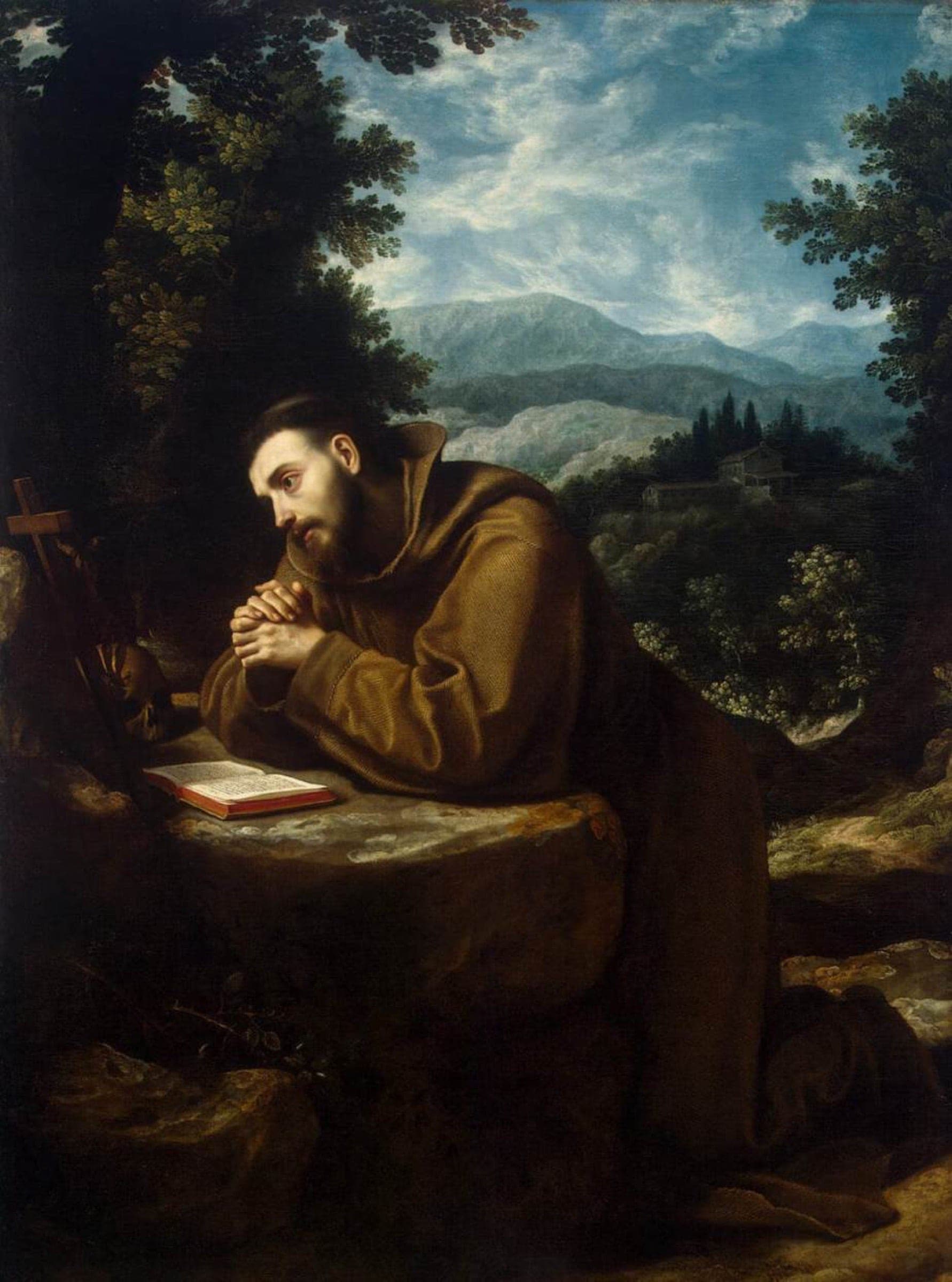
Lodovico Cigoli, Saint Francis in Prayer
La Verna

Prayer

Prayers and words of Francis and Clare, and one prayer long joined to his name. Read slowly, aloud if you can, and let each line rest before the next.

Lodovico Cigoli · Saint Francis in Prayer · Late 16th century

St Francis of Assisi

Prayer before the Crucifix

Manuscripts from the later Middle Ages record that the young Francis prayed before the crucifix in the church of San Damiano at Assisi in words close to these, and scholars date the prayer to about 1205 or 1206, at the very start of his conversion. This English version, published anonymously in 1882, translates the longer Latin form printed by Luke Wadding in 1623, which differs a little from the shorter text usually prayed today.

O great and glorious God, and my Lord Jesus Christ, enlighten, I beseech Thee, the darkness of my mind. Give me a right faith, a certain hope, a perfect charity; grant that I may know Thee, O Lord, in order that I may always and in all things act according to Thy most holy and perfect will. Amen.

Source

St Francis of Assisi

We Adore Thee

In his Testament, set down shortly before his death in 1226, Francis recalled the faith the Lord gave him in churches, and the simple prayer he would say in them. Thomas of Celano and St Bonaventure record that he taught this same prayer to his first brothers when they asked him how to pray.

We adore Thee Lord Jesus Christ here and in all Thy churches which are in the whole world, and we bless Thee because by Thy holy cross Thou hast redeemed the world.

Source

St Francis of Assisi

The Canticle of Brother Sun

Francis composed this song of praise in his Umbrian Italian in 1225, while ill and lodged in a small hut beside San Damiano, where St Clare and her sisters lived. According to early tradition he added the verse on pardon and peace during a feud between the bishop and the podestà (chief magistrate) of Assisi, and the verse on Sister Death as his own death approached; this prose translation is by the English poet and critic Matthew Arnold (1865).

O most high, almighty, good Lord God, to thee belong praise, glory, honour, and all blessing!

Praised be my Lord God with all his creatures; and specially our brother the sun, who brings us the day, and who brings us the light; fair is he, and shining with a very great splendour: O Lord, he signifies to us thee!

Praised be my Lord for our sister the moon, and for the stars, the which he has set clear and lovely in heaven.

Praised be my Lord for our brother the wind, and for air and cloud, calms and all weather, by the which thou upholdest in life all creatures.

Praised be my Lord for our sister water, who is very serviceable unto us, and humble, and precious, and clean.

Praised be my Lord for our brother fire, through whom thou givest us light in the darkness; and he is bright, and pleasant, and very mighty, and strong.

Praised be my Lord for our mother the earth, the which doth sustain us and keep us, and bringeth forth divers fruits, and flowers of many colours, and grass.

Praised be my Lord for all those who pardon one another for his love’s sake, and who endure weakness and tribulation; blessed are they who peaceably shall endure, for thou, O most Highest, shalt give them a crown!

Praised be my Lord for our sister, the death of the body, from whom no man escapeth. Woe to him who dieth in mortal sin! Blessed are they who are found walking by thy most holy will, for the second death shall have no power to do them harm.

Praise ye, and bless ye the Lord, and give thanks unto him, and serve him with great humility.

Source

  • Essays in Criticism. “Pagan and Mediæval Religious Sentiment”, pp. 246–247. Translated by Matthew Arnold (first published 1865; text from the London edition of 1875).

St Francis of Assisi

The Praises of God Most High

On Mount La Verna in 1224, after receiving the stigmata, Francis wrote these praises in his own hand on a small sheet of parchment that he gave to his companion Brother Leo. The sheet, known as the chartula, is still preserved at the Sacro Convento in Assisi.

Thou art holy, Lord God, who alone workest wonders. Thou art strong. Thou art great. Thou art most high. Thou art the Almighty King, Thou, holy Father, King of heaven and earth. Thou art the Lord God Triune and One; all good. Thou art good, all good, highest good, Lord God living and true. Thou art charity, love. Thou art wisdom. Thou art humility. Thou art patience. Thou art security. Thou art quietude. Thou art joy and gladness. Thou art justice and temperance. Thou art all riches to sufficiency. Thou art beauty. Thou art meekness. Thou art protector. Thou art guardian and defender. Thou art strength. Thou art refreshment. Thou art our hope. Thou art our faith. Thou art our great sweetness. Thou art our eternal life, great and admirable Lord, God Almighty, merciful Saviour.

Source

St Francis of Assisi

A Blessing for Brother Leo

On the other side of the same sheet Francis wrote this blessing for Brother Leo, drawing on the priestly blessing of Numbers 6:24–26, and marked it with a tau, the T-shaped sign he used as his signature. Leo later added a note that Francis had written the blessing for him with his own hand.

May the Lord bless thee and keep thee. May He shew His face to thee and have mercy on thee. May He turn His countenance to thee and give thee peace. Brother Leo may the Lord bless thee.

On the parchment Francis drew the tau so that it divides Leo’s name, and Robinson’s edition prints the tau inside the name.

Source

St Francis of Assisi

Salutation of the Blessed Virgin Mary

In this short litany Francis greets Mary as the palace, tabernacle, house, garment, handmaid and Mother of the Lord, and then greets the holy virtues that the Holy Spirit pours into the hearts of the faithful. It is found in the early manuscript collections of his writings, and the scholars who edited them accept it as his own.

Hail, holy Lady, most holy Queen, Mother of God, Mary who art ever Virgin, chosen from Heaven by the most Holy Father, whom He has consecrated with the most holy beloved Son and the Ghostly Paraclete, in whom was and is all the fulness of grace and all good. Hail thou His palace! Hail thou His tabernacle! Hail thou His house. Hail thou His garment! Hail thou His handmaid! Hail thou His Mother and all ye holy virtues which by the grace and illumination of the Holy Ghost thou infusest in the heart of the faithful, that from infidels ye mayest make them faithful to God.

Source

St Francis of Assisi

Salutation of the Virtues

Francis greets the virtues as noble ladies, each one paired with a sister virtue, and then shows how each overcomes its opposing vice. His earliest biographer, Thomas of Celano, quoted its opening words in his Second Life of Francis, written about 1247.

Hail, queen wisdom! May the Lord save thee with thy sister holy pure simplicity! O Lady, holy poverty, may the Lord save thee with thy sister holy humility! O Lady, holy charity, may the Lord save thee with thy sister holy obedience! O all ye most holy virtues, may the Lord, from whom you proceed and come, save you! There is absolutely no man in the whole world who can possess one among you unless he first die. He who possesses one and does not offend the others, possesses all; and he who offends one, possesses none and offends all; and every one [of them] confounds vices and sins. Holy wisdom confounds Satan and all his wickednesses. Pure holy simplicity confounds all the wisdom of this world and the wisdom of the flesh. Holy poverty confounds cupidity and avarice and the cares of this world. Holy humility confounds pride and all the men of this world and all things that are in the world. Holy charity confounds all diabolical and fleshly temptations and all fleshly fears. Holy obedience confounds all bodily and fleshly desires and keeps the body mortified to the obedience of the spirit and to the obedience of one’s brother and makes a man subject to all the men of this world and not to men alone, but also to all beasts and wild animals, so that they may do with him whatsoever they will, in so far as it may be granted to them from above by the Lord.

Source

St Francis of Assisi

Where There Is Charity and Wisdom

The Admonitions are short spiritual counsels that Francis left to his brothers. In this one, each virtue leaves no room for its opposing vice. The early sources give no date or occasion for the Admonitions, but scholars accept them as his own.

Where there is charity and wisdom there is neither fear nor ignorance. Where there is patience and humility there is neither anger nor worry. Where there is poverty and joy there is neither cupidity nor avarice. Where there is quiet and meditation there is neither solicitude nor dissipation. Where there is the fear of the Lord to guard the house the enemy cannot find a way to enter. Where there is mercy and discretion there is neither superfluity nor hard-heartedness.

Source

St Clare of Assisi

Place Your Mind in the Mirror of Eternity

St Clare of Assisi, first abbess of San Damiano, wrote letters to Agnes of Prague, a Bohemian princess who had founded a monastery of Clare's order in Prague and entered it herself in 1234. This passage comes from the third of Clare's four surviving letters to Agnes, written in 1238.

Rejoice also, O most beloved, rejoice always in Our Lord, and let not any bitterness lay hold on you.

O sweet virgin, beloved in Christ, the joy of angels, and the crown of our sisters, place your mind in the mirror of eternity; place your soul in the figure of the Divine Substance, and in contemplating God transform yourself into an image of His Deity. Then you shall feel what His friends feel, and you shall taste the secrets of the joy which the Almighty God keepeth in hiding from the beginning for His chosen ones, and for all those who give themselves to Him, though they still dwell in this deceitful world which seduces those who blindly serve it.

Love Him with your whole heart who with a whole heart offered Himself for you.

…

For I believe most truly, by God's grace, that the soul of a faithful man, that most noble thing in all creation, is even greater than heaven, since heaven together with all created things cannot contain the Creator; whereas He makes His dwelling-place and His throne in one single, faithful soul, because of that love which the wicked man has not. So says the Word of Truth; “He that loveth Me is loved by My Father, and I will love him, and we will come to him and will make our abode with him.”

The glorious Virgin bore in her virginal womb the God of virgins and true man. So you, by imitating her in humility and poverty, are able mystically to bear within you the same Lord, containing Him by whom all things are contained, and more and more fully will He dwell within you and within those who spurn the riches of this world.

Source

St Clare of Assisi

Take to Your Heart Poor Christ

In her second letter to Agnes of Prague, a Bohemian princess who had joined her order, St Clare encourages her friend to persevere in the poor life she had chosen and to look upon Christ crucified. The letter was probably written between 1235 and 1238.

This thing only I press upon you because it is the one thing needful. I exhort you by the love of Him to whom you have offered yourself as a sacrifice that you will be ever mindful of your vocation. Like another Rachel, be ever looking back to its beginning. What you have already, keep; what you have done, do still. Never stand still, but run swiftly, in steadfast imitation and with eager feet, lest in your progress you catch the dust. Go forward with joy and certainty in the way of so great blessedness. Believe no one, consent to none who would draw you from this purpose or who causes any stumbling-block to fall in your way. Run in that way of perfection to which the spirit of God has called you, so that in it you may fulfil your vows to the Most High, and with greater surety tread the way of God's commandments.

…

But, like a poor virgin, take to your heart poor Christ. Look upon Him, made full of contempt for your sake, and follow Him. Make yourself full of contempt for His sake in this world.

Look, O most noble Queen, upon your Spouse, and see how He was lovely beyond the sons of men, and yet became unlovely amongst men for your salvation. His body was torn by scourges, and He died in dire torments upon the Cross.

Burn with a great longing to liken yourself to Him. If you endure pain now, you shall enjoy glory. If you share His sorrow, you shall share His joy. If you make your dwelling upon the Cross, you shall share a heavenly dwelling with Him in the brightness of the saints. Your name will be written in the book of life, to be glorious in the ages of ages. You shall exchange the passing things of this world for eternal possessions and live in unending joy.

“Full of contempt” here means made lowly and despised in the world’s eyes, as Christ was.

Source

Attributed to St Clare of Assisi

The Blessing of St Clare

Tradition holds that St Clare gave this blessing to her sisters, present and future, shortly before her death in Assisi on 11 August 1253. Its text is known only from later sources, including the chronicler Mark of Lisbon (died 1591), and scholars have questioned whether Clare herself composed it.

In the name of the most Holy Trinity. Amen. May the Omnipotent God bless you, dear sisters, may He make His countenance to shine upon you, and have pity on you; may He give you His peace.

And not only you who may be present at my death, but also all those absent; also every one who after you shall enter my Order, and shall persevere unto the end in her vocation—be it in this convent, or any other of the same profession. I therefore, Clare, useless servant of Jesus Christ, unworthy plantlet of our Father St. Francis; I, your sister and mother, pray the Lord God for His most loving compassion, and by the intercession of the most Blessed Virgin Mary, His mother, and the Archangel Michael, and our guardian angels, and our Seraphic Father, that He may grant you His blessing, and thus confirm from heaven that which I leave you in His name. May He deign to pour out on you here on earth the abundance of His grace, to call you to heaven, admitting you to the choir of the saints who enjoy the Beatific Vision.

I give you my blessing at present while alive, and confirm it after my death. I leave you all the benedictions that I can, and I implore them for you from that God who lives and reigns for ever and ever. Amen.

Source

Author unknown, first printed 1912

The Peace Prayer

Saint Francis did not write this prayer: it first appeared, with no author's name, in a small French Catholic magazine, La Clochette, in December 1912, and it became attached to his name in the 1920s, a few years after a French Franciscan printed it on the back of a holy card of the saint. The English text below is taken from the printed minutes of an ecumenical church meeting held at Berne, Switzerland, in August 1926.

Lord, make me an instrument of your peace; where there is hatred, let me sow love; where there is injury, pardon; where there is discord, union; where there is doubt, faith; where there is despair, hope; where there is darkness, light; and where there is sadness, joy.

O Divine Master, grant that I may not so much seek to be consoled, as to console; to be understood, as to understand; to be loved, as to love; for it is in giving that we receive, it is in pardoning that we are pardoned, and it is in dying that we are born to eternal life. Amen.

Source