
La Verna
Reading
Stories of Francis, Clare and those who followed them, mostly as the early lives and the Little Flowers tell them. Choose one and take your time.
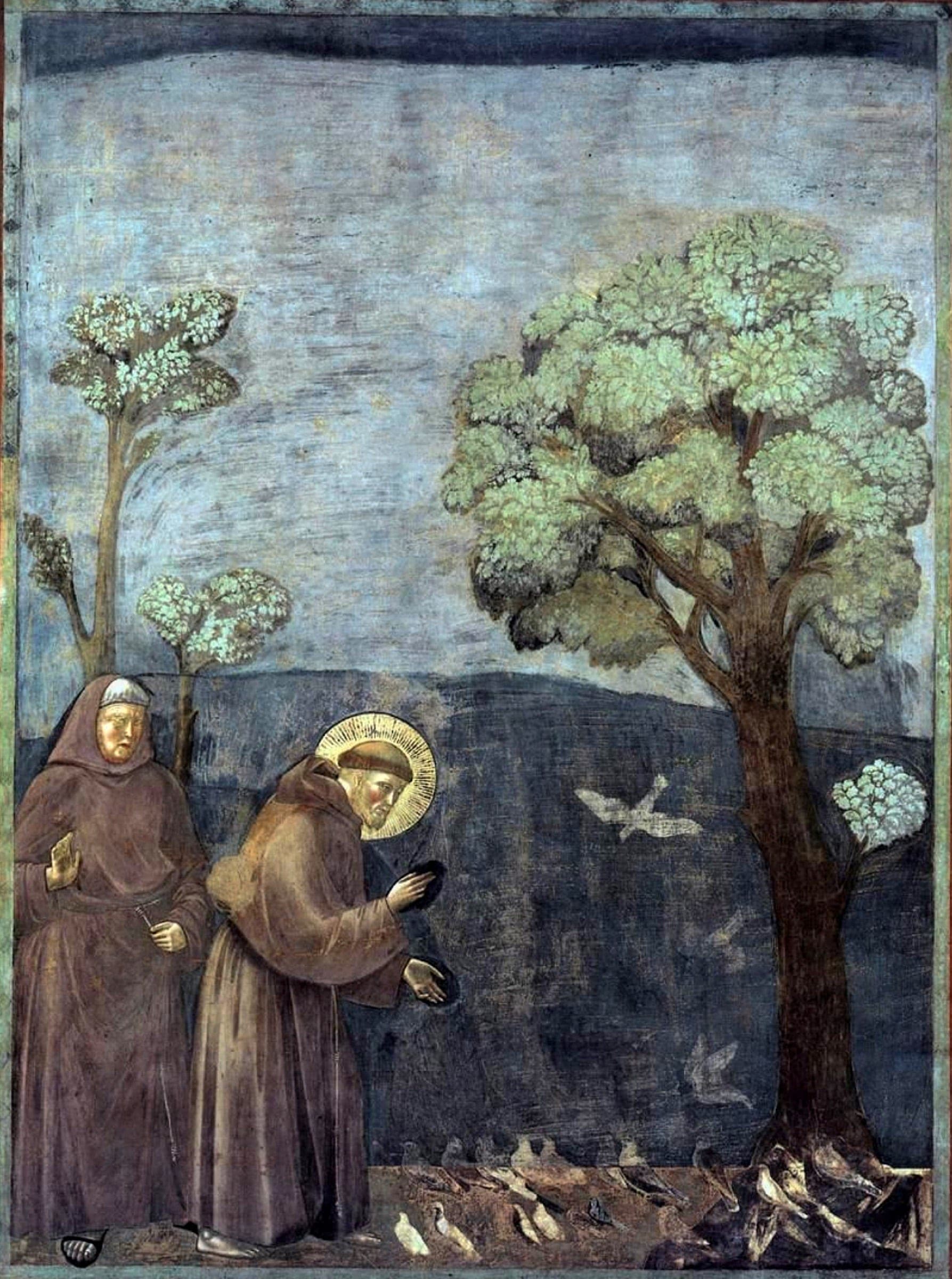
Attributed to Giotto · St Francis Preaching to the Birds · c. 1297–1300
St Francis of Assisi
From his own Testament, the early lives and the Little Flowers.
- Francis Meets the LeperWhile Francis was still living in the world and searching for what God wanted of him, he met a leper as he rode across the plain below Assisi. St Bonaventure tells the story near the start of his Legenda Major, among the things Francis did before he had taken the religious habit.
- The Lord Led Me Among the LepersFrancis set down his Testament in 1226, in the last months of his life, and he opened it by remembering how the Lord led him among lepers, so that what had seemed bitter was turned into sweetness. He goes on to recall the faith he was given in churches and in priests.
- The Crucifix at San DamianoAfter turning back from a military expedition in about 1205, the young Francis of Assisi was seeking God in prayer and solitude when he went in to pray before an old crucifix in the neglected chapel of San Damiano below the town. This account comes from St Bonaventure's Legenda Major, which the General Chapter of the Friars Minor meeting at Pisa in 1263 recognised as the official life of Francis.
- Before the Bishop of AssisiFrancis's father, Pietro Bernardone, a wealthy cloth merchant of Assisi, was angered that his son had sold goods to pay for restoring the chapel of San Damiano, and he brought Francis before the Bishop of Assisi to make him give up his inheritance. St Bonaventure tells what happened there in his Legenda Major.
- The Sermon to the BirdsUnsure whether to give himself wholly to prayer or to go out preaching, Francis asked Brother Sylvester and St Clare to pray for guidance, and both answered that he should preach. He set out at once, and near Bevagna, a town in Umbria, he met the birds; St Bonaventure tells the story in the chapter of his Legenda Major on Francis's preaching.
- Perfect JoyIn this chapter of the Little Flowers of St Francis, an Italian work made from a Latin collection compiled some time after 1322, Francis walks with Brother Leo on a bitterly cold winter's day from Perugia to St Mary of the Angels. On the way he teaches Leo where perfect joy is truly found.
- Francis before the SultanIn 1219, while the crusaders besieged Damietta in Egypt, Francis and his companion Brother Illuminato crossed to the opposing camp and were brought before the Sultan, al-Malik al-Kamil. Bonaventure wrote this account more than forty years later; a contemporary witness, Jacques de Vitry, records that the Sultan received Francis with courtesy.
- The Wolf of GubbioThis story comes from the Little Flowers of St Francis, an Italian work made from a Latin collection compiled some time after 1322. It tells how Francis, while staying in the city of Gubbio, made peace between its people and a fierce wolf that had terrorised them.
- The Crib at GreccioSt Bonaventure's Life of St Francis, officially approved by the Franciscan general chapter at Pisa in 1263, recalls the Christmas of 1223, when Francis kept the feast at Greccio with a manger, an ox and an ass. For many episodes Bonaventure abridged earlier accounts, especially that of Thomas of Celano.
- The Seraph on La VernaIn August 1224 Francis withdrew to La Verna (called Mount Alvernia in this translation), a peak in the Tuscan Apennines, to keep a forty-day fast before the feast of St Michael. On or about the feast of the Exaltation of the Cross, 14 September, he saw the vision of the seraph and received the marks of Christ's wounds.
- The Death of FrancisFrancis died at the Portiuncula, the little church of St Mary of the Angels in the plain below Assisi, on the evening of Saturday 3 October 1226. Bonaventure tells how he lay on the bare ground, prayed Psalm 142 (141 in the Latin numbering this text follows) to its last verse, and how larks (here simply "certain birds") circled the roof at the hour of his death.
St Clare of Assisi
From the Legend of St Clare and the Little Flowers.
- Palm Sunday: Clare Leaves HomeClare was about eighteen when, on the night after Palm Sunday 1212 (18 March, the date given in Robinson's notes), she slipped out of her family's house in Assisi and went down to the little church of St Mary of the Porziuncola, where Francis and his friars received her. Some modern writers, Pope Benedict XVI among them, allow that the year may have been 1211.
- Francis and Clare at TableThis story comes from the Little Flowers of St Francis, a collection of popular legends about Francis and his early companions that an unknown friar put into Italian in the fourteenth century. Clare, who lived with her sisters at San Damiano outside Assisi, comes to share a meal with Francis at St Mary of the Angels (the Portiuncula), the little chapel where she had been received into religious life.
- Clare Blesses the BreadIn this legend from the Little Flowers of St Francis, a pope visiting Clare’s convent asks her, under obedience, to bless the bread herself rather than blessing it himself. The text does not name the pope; Clare was abbess of San Damiano, just outside Assisi, from about 1215 until her death in 1253.
- Clare and the SaracensIn September 1240, the date most modern accounts give, troops of the Emperor Frederick II, among them Saracen archers descended from the Saracens who had once ruled Sicily, broke into the enclosure of San Damiano just outside Assisi. Clare, who was ill, had herself brought to the door with the Blessed Sacrament carried before her, and prayed.
- Christmas Night at San DamianoClare was ill for much of her later life, and this episode is generally placed at Christmas 1252, her last Christmas, when she was too weak to join her sisters for Matins in the oratory of San Damiano. The Church of San Francesco, where the friars were singing the night office, lies about two kilometres away as the crow flies.
- The Death of ClareClare died at San Damiano before dawn on 11 August 1253, two days after Pope Innocent IV solemnly confirmed the Rule of her sisters. Brother Leo and Brother Angelo, two of the early companions of Francis, were at her bedside.
Those who followed
Friars who walked the same road, from Francis’s first companions to the twentieth century.
- St Anthony of PaduaSt Anthony Preaches to the FishesSt Anthony of Padua, born in Lisbon in about 1195, belonged to the first generation of Franciscan friars; he died near Padua on 13 June 1231 and was proclaimed a Doctor of the Church in 1946. The Little Flowers of St Francis sets his famous sermon to the fishes at Rimini, though some accounts place it on the river Brenta near Padua.
- Brother JuniperBrother Juniper and the Pig’s FootBrother Juniper was one of the early companions of St Francis, remembered for his deep humility and for a charity so simple that it could run ahead of good sense. This story is the first chapter of the Life of Brother Juniper, a set of stories about him that was probably added to the Little Flowers as an appendix by later compilers.
- St BonaventureBonaventure on La VernaIn the autumn of 1259 Bonaventure, then Minister General of the Franciscans, went to Mount La Verna, where Saint Francis had received the stigmata. This retelling follows his own account in the prologue of the book that came from that visit.
- St Maximilian KolbeMaximilian Kolbe at AuschwitzMaximilian Kolbe, a Polish Conventual Franciscan friar, was killed at Auschwitz on 14 August 1941 after offering his life in place of another prisoner. This retelling follows the accounts of the Auschwitz Memorial and the Holy See.